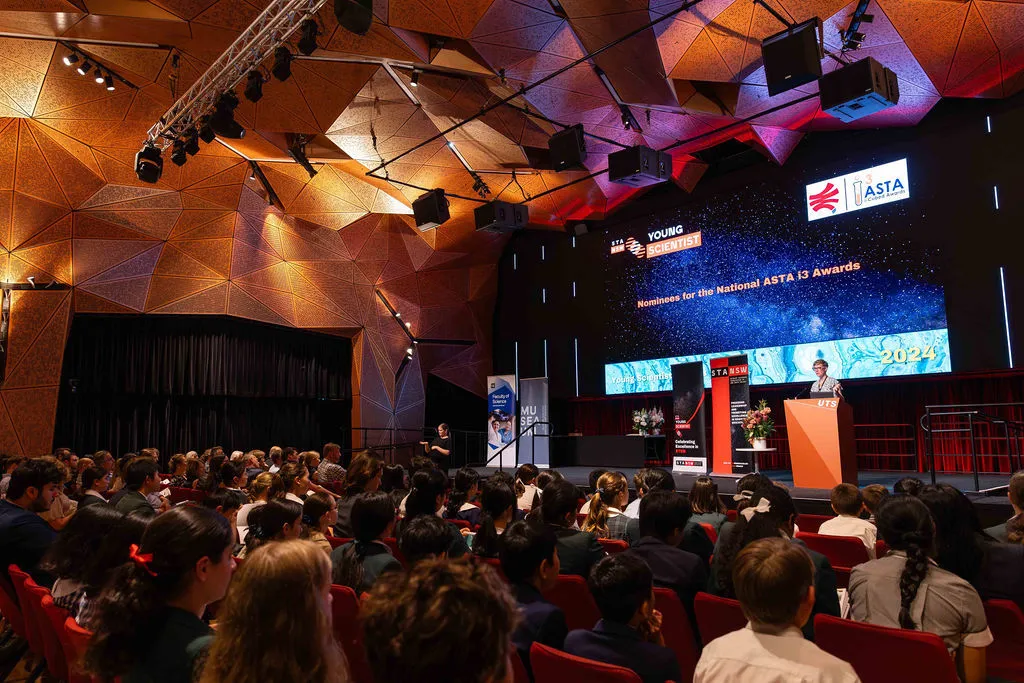
Five Northern Beaches students will be receiving awards at the Young Scientist Awards Ceremony next week for their science projects, and they are in the running for the prestigious title of Young Scientist of the Year.
Clement Charbonneau from Killarney Heights High School investigated ways to identify a safe, potable water source for small rural Australian communities, while Mona Vale Public School students Niri C, Jimi S and Lachie J explored the placebo effect. Daniel Evans from Northern Beaches Christian School turned his attention to an important environmental challenge, investigating which method is most effective at removing microplastics from saline water.
Held at University of Technology Sydney (UTS) on Friday 27 November, this will mark the 66th year of the Young Scientist Awards Program, a state-wide competition that celebrates scientific and technical innovation of K-12 school students around NSW. Since 1960, the program, run by the Science Teachers’ Association of New South Wales (STANSW), has encouraged students to undertake innovative projects and investigations to find creative solutions to real-world problems.
This year’s competition attracted more than 500 project entries from Kindergarten to Year 12 students across NSW. A record number of over 150 monetary prizes totalling over $24,000 will be awarded to students for their innovative science projects across the categories of Earth and Environmental Science, Physics, Biology, Chemistry, Scientific Investigation, Technological Innovations and Climate Action.
Vice President of The Science Teachers’ Association of New South Wales, Dr Lauren McKnight, says the Young Scientist Awards provide a platform for students to showcase their scientific curiosity, thinking and creativity.
"Climate Action is a significant theme this year, with a dedicated category offering more than $6,000 in sponsored prizes. The category encourages students to develop innovative solutions to reduce greenhouse gas emissions while highlighting the important role of science and technology careers in Australia's transition to a net zero future," Dr McKnight said.
“It’s incredible to see student curiosity and interests come to life through scientific investigation. This year we’ve seen students test solutions to real-world challenges, from assistive technologies and safety systems to bridges, turbines, robotic devices and vehicle aerodynamics.
“Other projects investigate microplastics in freshwater and soils, rubber crumb pollution, antimicrobial resistance in the environment, water quality, groundwater recharge and effects on plant growth. It shows just how passionate and bright our young minds are.”
“These experiences help young people see science not just as a subject, but as a way of understanding and shaping the world around them. By celebrating their achievements, we’re recognising the creativity, persistence, and critical thinking that fuel Australia’s future innovation.”
The program now accepts a broader range of submission formats alongside traditional written reports, recognising that students communicate scientific investigations and technological innovations in different ways. This makes the competition more accessible and encourages even more students to participate.
This year's Young Scientist Awards are supported by program sponsors including University of Technology (UTS), Powerhouse, Rowe Scientific, Australian Skeptics, Anzuk Education, AIP, RACI and Passionately Curious.
The Young Scientist of the Year and other prizewinners will be published after the ceremony on the Science Teachers’ Association of New South Wales website: www.stansw.asn.au
After the Young Scientist Awards Ceremony, selected students from each region of NSW will be invited to represent the state at the Australia Wide Science Fair – The ASTAi Cubed Awards. Senior students are also invited to contribute to The Young Australians Science Journal (YASJ).
About the Science Teachers’ Association of NSW
Founded in 1951, the Science Teachers’ Association of NSW (STANSW) is committed to advancing the profession of science education in New South Wales, with a focus on the professional learning, support, and advocacy of its teacher members.
Embracing the passion of science educators who volunteer their time, the association provides leadership and support to its members. As education systems and pedagogy evolve, STANSW strives to serve as a voice for our teacher members, providing them with the support and guidance required to adjust to change and consistently deliver excellence in science teaching.