
.webp)

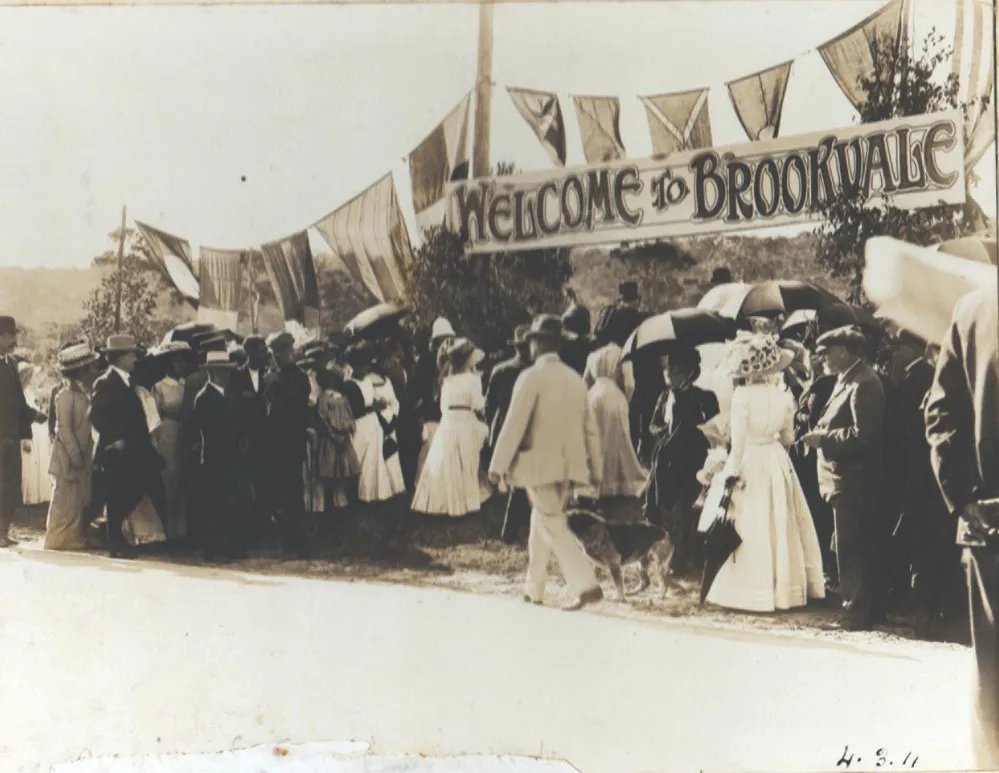
Brookvale is living proof a suburb can move to its own rhythm. It has been farmland, market garden, factory floor, surf city and now one of Sydney's most talked-about nights out. The nightlife is pumping, live music spills onto the streets, and friends wander from one brewery to the next. To understand what Brookie is today, you have to go back to the creek, the tram, the Chinese market gardens, the Italian families, and the six blokes who shaped the nation's surfboards from sheds on the very same streets where your craft beer now waits.
BEFORE THE BREWERIES
Before William Frederick Parker sank a spade into the soil, this land had been cared for by Aboriginal people for thousands of years. The flat, well-watered valley between Beacon Hill and the coast was productive country, rich in food and resources. Rock engravings remain in the area today, quiet evidence of a deep and continuous connection to this place. When colonial settlement came, it brought disease and displacement.
In 1836 an English settler named William Frederick Parker purchased around 100 acres of bushland north of Manly and set about farming it. A creek ran through the property and Parker, a man who kept things simple, named his holding Brookvale Farm. The name did not stick to the wider suburb immediately. For years the area went by Greendale, after a larger parcel of land nearby. That changed in 1887 when Brookvale Public School opened, specifically to avoid confusion with another school of the same name. The postal authorities caught up a year later. By 1888 it was Brookvale on the map. The creek had won.
The creek that gave the suburb its name still runs today. It rises in the bushland of Allenby Park, winds through the suburb and empties out at Curl Curl Lagoon. Its lower reach still carries the old name, Greendale Creek, long after the suburb moved on.
Brookvale Public School opened on 1 November 1887, the second government school established on the Northern Beaches after Manly. Its first class was 21 children with one teacher, Miss Elizabeth Lawson, in a rented hall on land Parker had donated to the church. By 1901 it had outgrown those rooms and moved to its current site on the corner of Old Pittwater and Pittwater Roads, with 36 pupils. That building is still there, still in use, 138 years on.
By the early 1900s, Brookvale was a patchwork of small farms and market gardens tended mostly by Chinese settlers who had stayed in NSW after the gold rush, delivering produce by horse and cart across the Beaches. Through the 1930s, Italian and European families moved in. After the war, so many came from the tiny Calabrian village of Pazzano that the suburb picked up a nickname still used today: Pazzaniedu, Little Pazzano. The Curulli, Caputo and Bombardieri families still own significant portions of Brookvale.
On 16 April 1910, the first tram from Manly steamed into Brookvale dressed with palm leaves, wildflowers and pampas grass, led into the terminus by a brass band and pipers, cheered by locals lining Pittwater Road the whole way up. The journey took 23 minutes, thirty-two trips a day. With connection came everything else. Land subdivided, shops appeared, a proper village took shape. By September 1939 the tram was gone, outcompeted by double-decker buses in the same week war broke out in Europe. Within twenty years its old terminus had become the site of St Augustine's College.
FACTORIES, FOAM AND A FILM STAR
As the suburb grew, so did demand for building materials. The Manly Brick and Tile Company established the Brookvale Brickworks in 1913, quarrying clay and kaolin from Beacon Hill and sending it down a miniature railway to the factory below. The bricks that built a large slice of the Beaches came from right here. The quarry also turned up 220-million-year-old Triassic fossils, two species of which ended up at the Australian Museum, formally named Brookvalia and Beaconia in the suburb's honour.
Brookvale's industrial identity was not accidental. After WWII the suburb was selected under the Cumberland Planning Scheme as the main industrial zone for the entire Warringah region. By the mid-1960s some 70 factories had moved in and the market gardens were concreted over. Brookvale Bus Depot opened in 1952, later becoming the first depot in NSW to train a woman bus driver. The Chamber of Commerce and Industry followed in 1954.
When Parker's original land was sold to developers in 1961, it made way for Warringah Mall. Opened in 1963, it grew steadily until Westfield came knocking and the name changed in 2012. The dolphin fountain, sculpted by Victor Cusack, arrived in 1988 and still sits at the heart of the Mall. The Mall also holds a slice of cinema history: in 1983 a 15-year-old Nicole Kidman filmed one of her earliest screen roles here in the cult classic BMX Bandits.
In the same decade the factories arrived, six surfboard shapers set up workshops within a kilometre of each other: Barry Bennett, Gordon Woods, Bill Wallace, Scott Dillon, Greg McDonagh and Denny Keogh. The Brookvale Six. At their peak, eight in every ten surfboards sold on the east coast came from these sheds. Nat Young, Bob McTavish and Midget Farrelly all shaped boards here. They had a tradition too. Every Friday the Six took turns putting on a keg. Cheap industrial land, creative people making something worth coming back for, and a cold beer at the end of the week. Sixty years later the breweries moved into the same streets and the same sheds. Different product, same Brookie.
THE FORTRESS
In 1911 Jane Try donated land adjacent to the Warringah Shire Council chambers on one condition: public recreation only. For its first decades the oval was the heart of village life, hosting the annual Brookvale Show. The Manly Warringah Rugby League Club arrived in 1947 and the oval found its permanent identity. Jane Try's name lives on in the largest of the four grandstands, joined by the Ken Arthurson Stand (1995) and the Bob Fulton Stand, completed in 2022 as part of a 36.1 million dollar redevelopment.
Since entering the NSWRL in 1947, the Sea Eagles have won 8 premierships and played in 19 grand finals, dressed in maroon and white from day one. The club has produced some of the game's most iconic players, from Bob Fulton, Ken Irvine, Max Krilich, Graham Eadie and Cliff Lyons to Paul Vautin, Geoff Toovey, Des Hasler, Brett Stewart, Steve Menzies and Daly Cherry-Evans. In 2021 they recorded the biggest win in club history, thumping Canterbury 66 to 0. All three Trbojevic brothers, Tom, Jake and Ben, have pulled on the jersey. Under Kieran Foran, the Sea Eagles are climbing the ladder fast and proud crowds are pouring into 4 Pines Park.
Brookvale's flat land and high-traffic roads also made it natural territory for car dealerships. The strip along Pittwater Road was defined by Col Crawford Motors in 1967, now into its third generation and still family-run, joined today by Genesis Northern Beaches, Bill Buckle, BYD, Brookvale Mitsubishi, Titan Ford, Northern Beaches Nissan and more. The Brookie Hotel, meanwhile, has been making itself somewhere worth lingering for the better part of 70 years, the natural before-and-after for Sea Eagles fans since the day the club arrived.
BROOKIE NOW
As industrial leases turned over and rents stayed within reach, a new kind of tenant moved into the sheds and warehouses of the Pittwater-Winbourne-Harbord-Wattle Road precinct. The Brookie Trail now connects the breweries and distillers, most within easy sight of each other, and has built a calendar that has become a fixture on the Beaches social scene: BrookieFest each February, the Brookie Hoedown in July, Brooktoberfest in October and plenty in between.
Northern Beaches Council's Structure Plan proposes over a thousand new dwellings while explicitly protecting the industrial zones that make the suburb what it is. The plan envisions a proper town centre built around the B-Line hub and Warringah Mall, celebrating the night-time economy, the makers and the arts. Whether Brookvale keeps its grit through the process remains the question. From Aboriginal country to farmland, from tram terminus to surf city, from factory floor to Friday night destination, Brookvale has always done things its own way. And it just keeps getting more interesting.
Share this!


.webp)